

GermanUDS
DGN_ai-inaction
AI in Action

A compact two-module open course that explains how today’s large language models work, from pre-training and alignment to reasoning and safety.
-
Course Start:
-
Course End:
Estimated Effort:
10 h/week
Enrollment in this course is by invitation only
AI in Action
About This Course
Artificial intelligence is moving fast, from chatbots that answer questions to autonomous agents that plan, use tools, and act in the real world. This open course offers a compact, accessible, and up-to-date tour through the two most dynamic areas of modern AI: Large Language Models (LLMs) and AI Agent Systems.
In the first module, participants learn how large language models actually work: how they are pre-trained on massive text corpora, how alignment techniques such as RLHF and DPO turn raw models into helpful assistants, how prompting and chain-of-thought reasoning unlock their capabilities, and how researchers address safety, knowledge editing, and the detection of AI-generated text.
In the second module, the course follows the natural next step in AI’s evolution: wrapping LLMs with tools, memory, and planning to create autonomous AI agents. Participants explore what defines an agent, how agents call external tools and APIs, how multi-agent systems collaborate, how the fast-moving agent framework ecosystem is developing, and what safety and trust challenges arise when AI systems can take real-world actions.
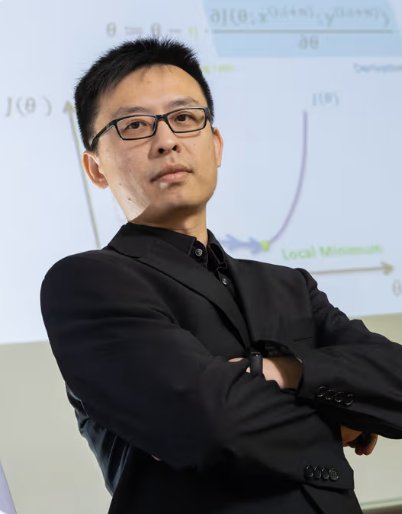
The course is taught by Prof. Dr. Haojin Yang (Chair for Efficient and Adaptive AI Systems, German University of Digital Science), a researcher and AI entrepreneur with extensive experience in efficient deep learning and agentic AI systems, in both academia and industry.
By the end of the course, you will:
- Understand how large language models are trained, aligned, and turned into the AI assistants we use every day
- Learn to work with LLMs more effectively and to judge their capabilities, limitations, and risks with a critical eye
- Discover how AI agents extend language models with tools, memory, and planning and what fundamentally sets an agent apart from a chatbot
- Understand the safety and trust challenges that arise when AI systems can act autonomously in the real world
- Gain the conceptual foundation to follow and join one of the fastest-moving fields in technology today
Learning Outcomes
After completing this course, participants:
- Can explain, in accessible terms, how modern large language models are built, aligned, and deployed, and critically discuss their capabilities and limitations
- Can apply effective prompting and reasoning strategies when working with LLM-based tools in study, research, or professional contexts
- Understand the conceptual architecture of AI agent systems and can evaluate when and how agentic approaches add value beyond a plain chatbot
- Can make informed judgments about the safety, security, and trustworthiness of LLMs and AI agents, including the risks of autonomous real-world actions
- Are prepared to follow — and participate in — the ongoing evolution of the field, from reasoning models to multi-agent systems and emerging Agent OS concepts
Required Skills
General IT knowledge
Course Level
Introductory
Who Is This Course For?
This course is designed for
- Students who want practical, future-ready skills to thrive in a digital learning environment.
- Educators who want to innovate their teaching
- Anyone eager to thrive in an AI-driven world.
Estimated Effort
3-6 hours per course week.
Duration
2 weeks
Upon Successful Completion
Confirmation of Participation
If you want to continue your learning journey, explore our study programs and discover more opportunities to grow with the German University of Digital Science. 👉 Discover our study programs
Course Lecturer
Prof. Dr. Haojin Yang
Haojin Yang is a researcher in multimedia and machine learning. He received his Ph.D. (summa cum laude) from the Hasso Plattner Institute (HPI). He previously led the Multimedia and Machine Learning (MML) research group at HPI (2017–2025) and has been habilitated for a professorship since 2019. His research focuses on efficient deep learning, model acceleration and compression, and agentic AI systems. He formerly served as Head of the Beijing branch of Alibaba AI Labs’ Edge Computing Laboratory (2019–2020) and as Chief AI Scientist at Huawei’s Edge-Cloud Innovation Lab (2021–2023). He has served on program committees of leading AI conferences such as NeurIPS, ICML, ICLR, AAAI, CVPR, and ICCV. He is founder and CEO of the AI startup GreenBitAI, advancing safer, more sustainable local AI agent systems and promoting AI equity.
Frequently Asked Questions
What web browser should I use?
Our German-UDS.academy platform works best with current versions of Chrome, Edge, Firefox, or Safari.
See our list of supported browsers for the most up-to-date information.